Group Reading Assessment Diagnostic Evalution Kathleen Williams
Diagnostic assessment plays an of import function in how teachers identify and empathize learning needs. It'southward important to understand that diagnostic assessment is not the same every bit diagnosis. By understanding the difference betwixt these two terms and how each might play a part in school-based supports for students, teachers will be in a strong position to back up all students' learning needs.
Process and Product
The best way to differentiate diagnostic cess from diagnosis is to understand that i is a process and the other is a production .
- Diagnostic Assessment = procedure of identifying the reason for a trouble
- Diagnosis = product of a comprehensive evaluation to friction match a pupil's presenting symptoms with the criteria for a specific disorder
Both of these terms have roles to play in identifying student learning challenges and needs, merely they serve very different purposes.
What is Diagnostic Cess?
Diagnostic assessment is the process of using multiple measures and reports to identify educatee strengths and needs in specific skill-areas so that teachers tin provide educational activity to address learning needs. Diagnostic cess straight guides academic, curricular, and instructional decisions because in that location is a better agreement of what a educatee does or does non know in relation to specific learning goals.
The types of assessments often used for the diagnostic assessment procedure include universal screening, classroom observations, progress monitoring, and qualitative data that are specific to the learning gap. Diagnostic assessment as well involves instruction in club to run across how a educatee responds to efforts to close learning gaps. Equally compared to more than general assessments, diagnostic cess seeks to identify the specific skills that a student needs to larn by isolating specific learning gaps.
Types of assessment often used in the diagnostic assessment process
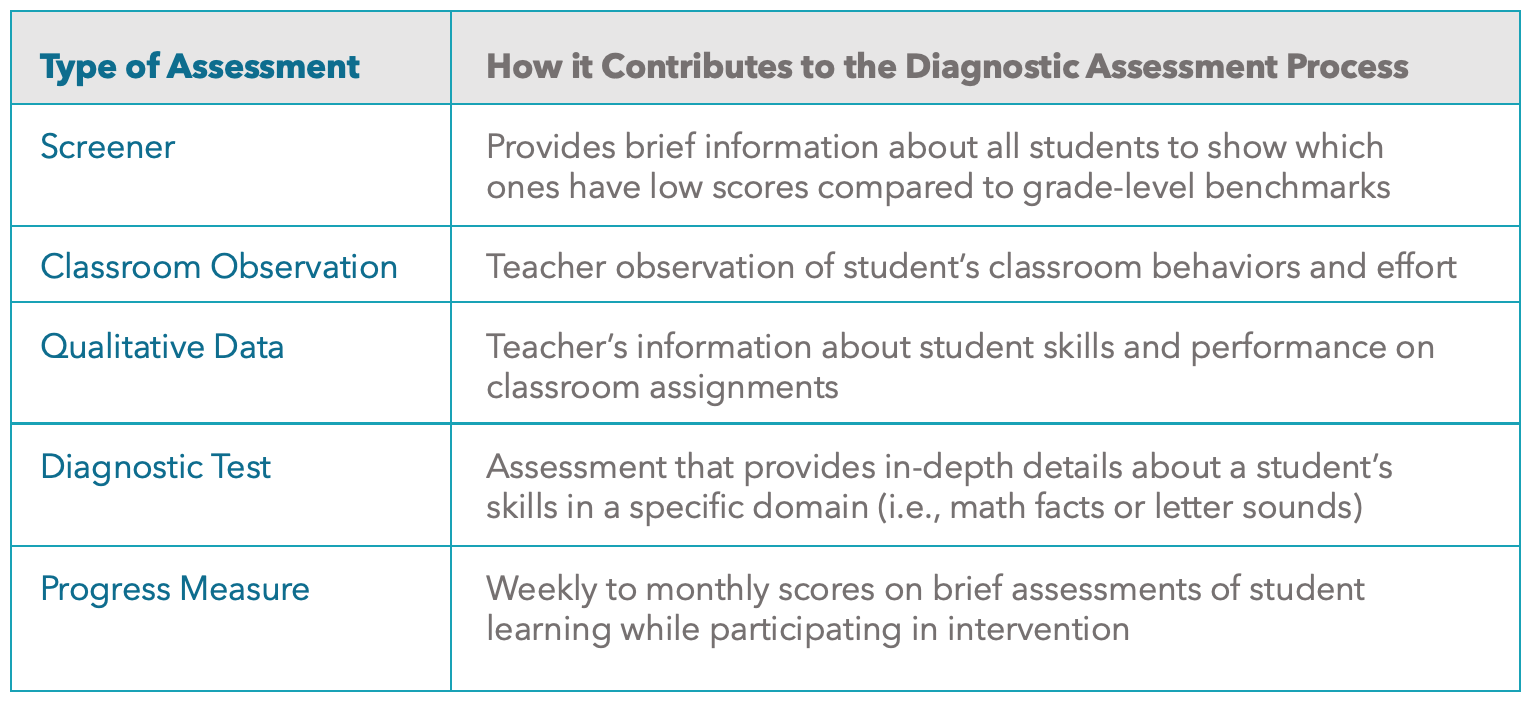
For example, universal screening cess results might testify that a pupil has weak decoding skills, but not which letter sounds the student needs to learn. Additional diagnostic assessment tin can exist used to assemble more detailed information. In this example, the teacher might have the student complete a letter sounds inventory along with a sight word measure out. These diagnostic data pinpoint what specific skills the student needs to larn. With that information, the teacher can provide instruction on those specific skills.
Diagnostic Assessment and Progress Monitoring
In society to measure student improvement, a progress measure out that matches the instructional focus should exist used at regular intervals. In the case of decoding instruction, weekly pseudoword decoding assessments would brand sense. When pupil progress information betoken improvement, then further assessment is not needed. If the progress information shows that the student is non making gains, then additional conscientious review of the intervention procedures and integrity besides every bit consideration of other options is needed. In some cases, boosted diagnostic cess might exist used to learn more about the specific learning gaps.
For many students, a procedure of diagnostic assessment and targeted teaching and intervention will result in learning improvements. For some students, the diagnostic assessment process and subsequent intervention with progress monitoring might non yield the gains needed. When a student does not make gains despite show-based instruction, implemented with integrity, it might be the case that the student meets the criteria for a learning disability and may qualify for special pedagogy services. (Chiefly, eligibility for special education does non require a diagnosis of a specific inability. In some cases, a formal diagnosis might be made as part of a comprehensive evaluation, but not always).
How Diagnosis is Different
As noted, diagnosis is the product of a set of procedures related to determining if a student demonstrates the characteristics, or symptoms, of a specific disorder. To determine if a diagnosis is nowadays, a number evaluation activities are conducted, including a a comprehensive evaluation to determine if the student qualifies; the presence of a diagnosis does not automatically mean that a student is eligible for special education. Instead, a team made up of the pupil's teacher, parents, specialists, a psychologist, and sometimes others must determine what evaluation data to asking and then meet to consider whether the accumulated data indicate the demand for special education services.
Many comprehensive evaluations are conducted by school-based specialists while others are completed by contracted specialists including clinical psychologists and physicians. The types of professionals who participate in comprehensive evaluation activities depend on the reason that the educatee was referred for evaluation. For students with already diagnosed medical weather such an orthopedic impairment, deafness, incomprehension, or Down syndrome, prior medical diagnosis can be used as part of the comprehensive evaluation.
For some referrals, the team will also need to gather recent information about the student'due south school performance equally well as acquit additional testing. The squad must review the accumulated data to determine if the pupil demonstrates persistent underachievement and volition benefit from specialized instruction.
Sometimes, a student who has been diagnosed with a sure disorder might non authorize for special teaching because overall achievement is stiff. However, the pupil's symptoms require some blazon of accommodations or supports to succeed in schools. Examples include students in wheelchairs who need ramps to navigate buildings or students who are hard of hearing who require priority seating and assistive hearing devices. The bodily instruction does not need to exist changed, simply schoolhouse staff do demand to accommodate the student's specific needs. In these cases, the student might qualify for what is known as a 504 plan. This blazon of program is based on the Americans with Disabilities Deed and a rule from section 504 of a police force related to supporting individuals with disabilities. All public schools are required to accept procedures to develop and implement 504 plans just equally they are special education programs.
Summary
Although both diagnostic assessment and diagnosis tin play important roles in supporting educatee success, these terms have very dissimilar meanings and uses in schools. Diagnostic assessment is a process whereby teachers identify and address student learning needs using a sequence of assessment and instruction. Diagnosis is the product of evaluation procedures, but is not required for special didactics services. Formal diagnoses are more common in cases of medical conditions merely are sometimes used when a learning inability or behavior disorder is present. For students whose diagnosis and current needs exercise not warrant special pedagogy services, a 504 programme might exist used to ensure accommodations so the student can admission learning opportunities.
*****
Illuminate Education equips educators to have a data-driven approach to serving the whole kid. Our solution combines comprehensive assessment, MTSS management and collaboration, and existent-time dashboard tools, and puts them in the hands of educators. As a outcome, educators can monitor learning and growth, place academic and social-emotional behavioral needs, and marshal targeted supports in order to accelerate learning for each student.
Prepare to detect your one-finish shop for your district'south educational needs? Let'south talk.
Group Reading Assessment Diagnostic Evalution Kathleen Williams
Source: https://www.illuminateed.com/blog/2020/11/diagnostic-assessment/
0 Response to "Group Reading Assessment Diagnostic Evalution Kathleen Williams"
Post a Comment